
There is something unsettling about a fine ruby. Diamonds sparkle with icy confidence and seem almost mathematical in their perfection. Rubies are different. They glow rather than glitter. They look as though they contain a small ember that refused to die centuries ago. For much of human history people did not simply admire rubies. They approached them with a curious mixture of desire and caution. In many cultures the stone was believed to protect its owner, reveal hidden dangers and sometimes punish those who possessed it without deserving it.
Modern gemology tells us that a ruby is simply the red variety of corundum, colored primarily by traces of chromium. That explanation is wonderfully accurate and spectacularly boring. Thousands of years before laboratories existed, people looked into these crimson stones and arrived at a much more entertaining conclusion. They believed something was living inside them.
In ancient Asia and across parts of Europe, rubies became symbols of blood, courage and royal authority. Their color was impossible to ignore. A deep untreated ruby resembled fresh blood illuminated by sunlight, and that alone inspired stories capable of surviving for generations. If blood carried life, then perhaps a stone with the same color carried concentrated life.
Some rulers believed a ruby should never be worn casually. It deserved respect much like a ceremonial sword or an ancient crown. Wearing one during negotiations, military campaigns or religious ceremonies was thought to strengthen resolve while warning dishonest companions that they stood in the presence of something beyond ordinary wealth.
Certain medieval chronicles described rubies as stones that could darken before danger arrived. Whether the approaching threat was poison, betrayal or battle, the ruby supposedly sensed it first. Unsurprisingly, historians have never found a surviving gemstone with an attached note reading, “I warned him, but he ignored me.”
Travelers carried these stories across continents. Merchants repeated them because remarkable stories sold remarkable stones. Every marketplace became a theater. One trader would swear a ruby had saved a prince from assassination. Another insisted his grandfather owned a stone that glowed brighter whenever enemies approached. By the end of the afternoon every ruby on the table seemed to possess a dramatic autobiography.
In parts of what is now Myanmar, historically one of the world’s greatest ruby sources, legends grew especially bold. Warriors were said to believe that carrying a ruby into battle made them harder to defeat. Some stories even claimed stones should be placed beneath the skin rather than simply worn as jewelry, allowing courage and protection to become part of the body itself. Whether anyone actually did this regularly is another matter, but the legend has proven remarkably durable.
Eastern Europe added its own layer of mystery. Folk traditions often viewed intensely colored gemstones with suspicion as much as admiration. An unusually vivid ruby might be considered a blessing in one village and an invitation for envy in the next. Objects that appeared too beautiful were sometimes believed to attract attention from forces better left undisturbed.
Unlike diamonds, which often symbolized endurance and permanence, rubies were associated with emotion. Passion, anger, loyalty, revenge, sacrifice and desire all gathered around the same crimson surface. A diamond promised stability. A ruby promised that something interesting was about to happen.
This difference affected the way gemstones appeared in literature. Diamonds frequently represented wealth. Rubies represented people. They became gifts between lovers, symbols of kingdoms, objects stolen during betrayals and rewards granted only after impossible journeys. If a story introduced a ruby, readers quietly expected someone to make a questionable decision before the final chapter.
Religion also played its part. Various traditions connected red gemstones with spiritual fire, sacrifice and divine favor. Rubies occasionally appeared in descriptions of sacred objects, ceremonial garments and heavenly imagery. Whether interpreted literally or symbolically, the stone gained an aura extending far beyond simple decoration.
Royal collections elevated these beliefs further. Kings and emperors competed not merely for the largest gemstones but for those surrounded by the grandest legends. A ruby connected with an ancient dynasty carried prestige impossible to reproduce through size alone. Provenance became almost as valuable as the gemstone itself.
The irony is that many famous historical “rubies” were not rubies at all. Before modern mineralogy developed, red spinels were frequently mistaken for rubies. Several celebrated crown jewels displayed in museums today spent centuries proudly introducing themselves as rubies before science politely interrupted the conversation.
One of the most famous examples is the Black Prince’s Ruby in the British Crown Jewels:
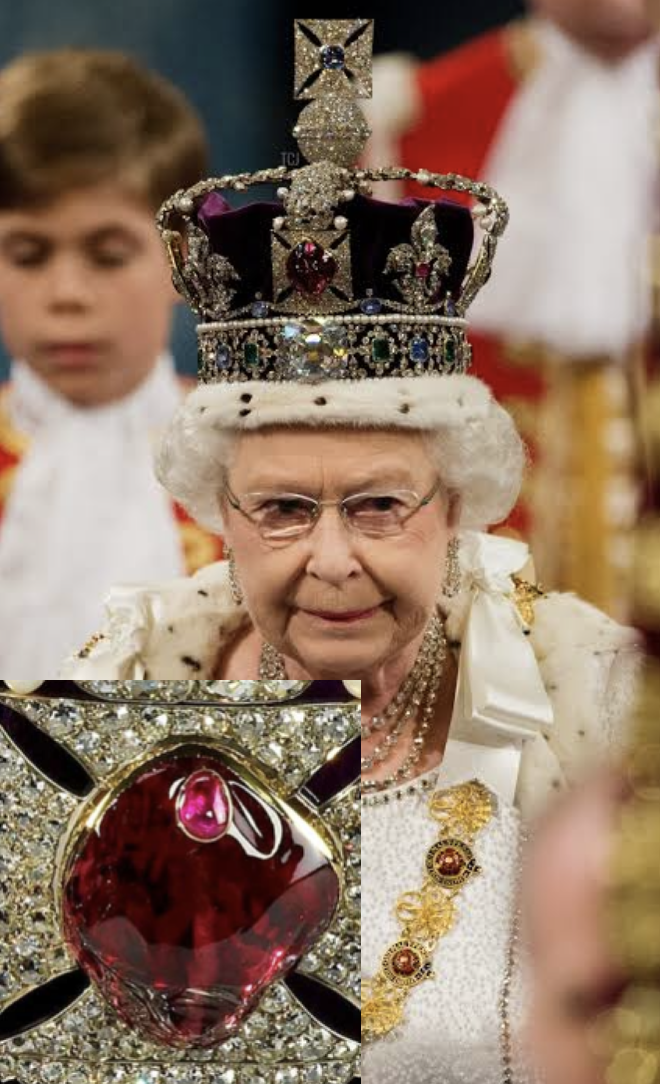
Despite its celebrated name, it is actually a magnificent red spinel. This revelation has done remarkably little to diminish its historical importance. If anything, it demonstrates that legends care surprisingly little about mineral classification.
Scientific understanding eventually transformed these mysterious objects into measurable specimens. Hardness could be tested. Chemical composition could be analyzed. Inclusions revealed geological history rather than supernatural personalities. The laboratory replaced the village storyteller, although it must be admitted that laboratory reports rarely inspire goosebumps.
Yet even modern gemology occasionally leaves room for wonder. Under ultraviolet light many rubies fluoresce with extraordinary intensity because of their chromium content. The glowing effect can appear almost magical to someone seeing it for the first time. Medieval observers would almost certainly have considered this decisive evidence that the stone possessed hidden fire.
Perhaps that explains why rubies still occupy a curious psychological space. They often feel warmer than diamonds despite having no meaningful difference in temperature. Their saturated color creates the illusion of energy, movement and internal light. Our brains remain surprisingly willing to believe that something extraordinary is happening beneath the polished surface.
The gemstone trade has not entirely abandoned dramatic storytelling either. Descriptions such as “pigeon blood red,” “royal ruby” and “legendary Burmese color” continue to appeal because buyers enjoy narratives almost as much as minerals. A gemstone becomes more memorable when it arrives with history attached.
Fortunately, modern buyers no longer need to worry about rubies punishing the unworthy or predicting assassination attempts. Today’s concerns are rather more practical. Has the stone been heated? Is there glass filling? Which laboratory issued the report? Is the color natural? Those questions may lack medieval romance, but they tend to produce better purchasing decisions.
Even so, standing before an exceptional untreated ruby remains an unusual experience. Fine examples possess a richness that photographs rarely capture. The finest stones seem to glow from somewhere beneath the surface rather than reflecting light only from above. Gem dealers sometimes smile knowingly when newcomers fall silent in front of an extraordinary ruby. It happens more often than one might expect.
Collectors occasionally describe their favorite ruby in strangely personal terms. They speak of temperament, character or presence. Scientifically these descriptions make no sense whatsoever. Psychologically they make perfect sense. Human beings have always assigned personalities to exceptional objects.
Perhaps this explains why rubies accumulated stranger legends than diamonds. Diamonds impress the intellect. Rubies provoke the imagination. One stone says, “Observe my perfection.” The other whispers, “Would you like to hear a story that may not be entirely true?”
Looking back, the old legends reveal less about gemstones than about ourselves. People feared betrayal, longed for protection, admired courage and searched constantly for signs that tomorrow might be understood before it arrived. Rubies became convenient vessels into which entire civilizations poured those hopes and anxieties.
Today we know that a ruby will not warn us of poison, choose the rightful king or burst into brighter flames before battle. It is a crystal formed under extraordinary geological conditions over immense spans of time. And yet, after all the spectroscopy, microscopy and laboratory reports have finished speaking, there remains a curious silence during which even the most rational observer finds themselves staring into that impossible red glow just a little longer than intended. Perhaps the ancient merchants understood one thing remarkably well. The finest rubies were never sold by chemistry alone.